Have Query ? Reach Out Us!

Have Query ? Reach Out Us!
09 Aug , 2026
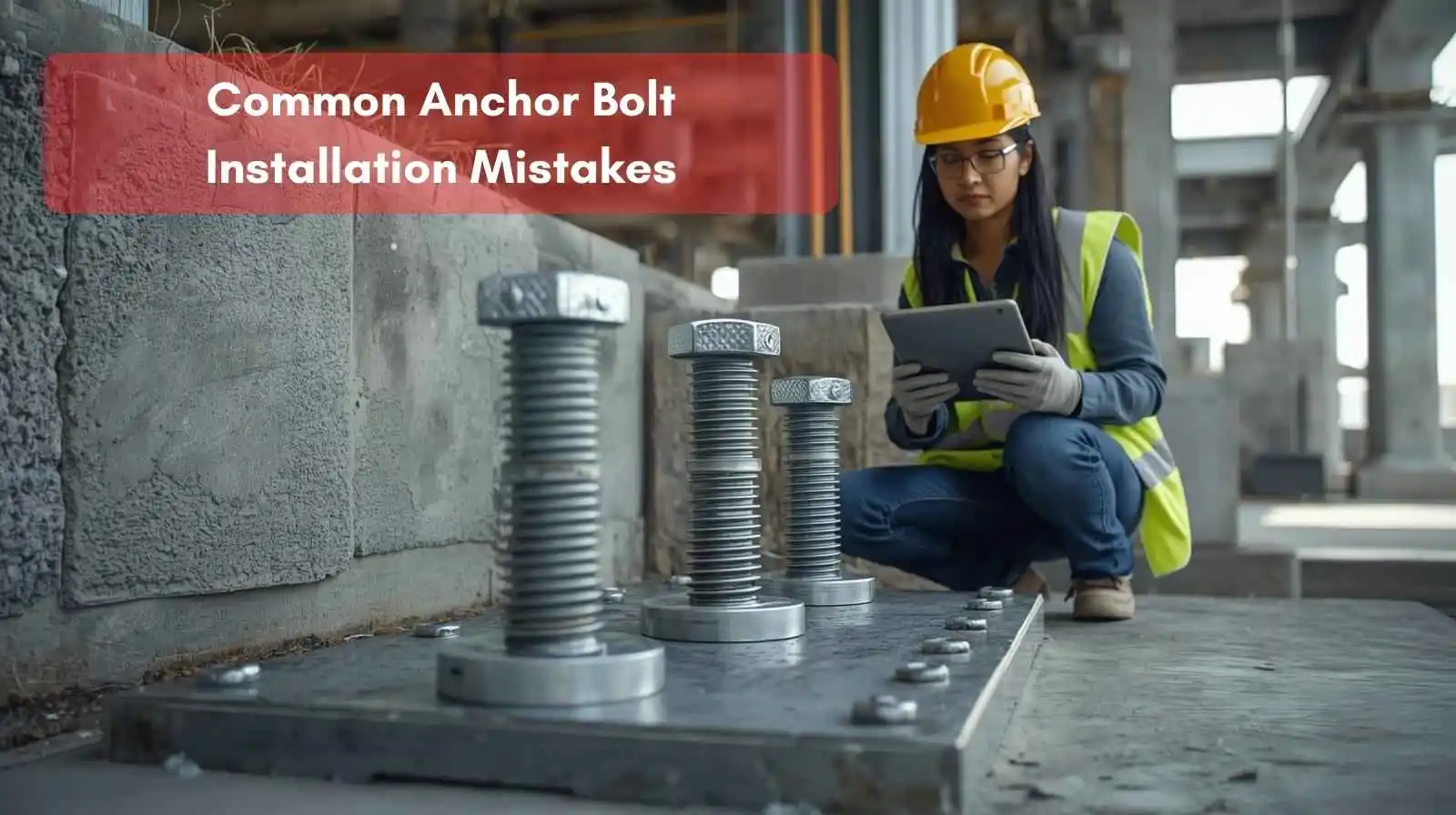
Anchor bolt failure is not always a material problem. In many projects, the real issue starts on site: wrong positioning, poor tolerances, incorrect embedment, bad edge distance, improper torque, mismatched hardware, poor adhesive installation, or weak inspection control. For B2B buyers and project teams, these mistakes can delay steel erection, create costly rework, weaken connection performance, and damage confidence in the supplier or installer. AISC notes that anchor rods and embedded items must be located according to approved embedment drawings and within erection-compatible tolerances; Simpson and Hilti technical material also show that reduced edge distance, reduced embedment, poor installation practice, and improper torque can directly affect anchor performance.
This guide explains the most common anchor bolt installation mistakes, why they happen, and what site teams should do to prevent them. It is written for real project use, not for textbook theory.
In industrial and structural work, anchor bolts are part of a full load path. They do not work alone. Their performance depends on base plate fit-up, concrete condition, embedment, edge distance, spacing, hardware compatibility, and installation quality. Even when the anchor itself is correctly manufactured, site mistakes can still reduce connection reliability or create immediate erection problems. Hilti technical guidance states that concrete failure becomes critical when embedment is reduced under tension or when distance from an edge is reduced under shear. AISC also emphasizes that tighter tolerances may be required when special conditions or smaller base-plate holes are used.
For that reason, installation quality is a commercial issue as much as a technical one. Delayed alignment, rejected hold points, and field rectification all increase project cost.
| Mistake | What Usually Goes Wrong | Likely Risk |
|---|---|---|
| Wrong layout or bolt location | Bolt group does not match template or base plate | Erection delay, rework, slot cutting, plate modification |
| Bolt out of tolerance / not plumb | Anchor rods not perpendicular or set inaccurately | Base plate fit-up issues, uneven load transfer |
| Incorrect embedment depth | Anchor is too shallow or not installed to required depth | Lower tension capacity, pull-out or breakout risk |
| Poor edge distance or spacing | Anchor placed too close to concrete edge or too close to adjacent anchors | Concrete breakout, splitting, reduced capacity |
| Incorrect torque | Over-tightening or under-tightening | Poor clamping, damaged anchor behavior, lower performance |
| Improper hole cleaning in adhesive anchors | Dust or debris left inside drilled hole | Lower bond strength, voids, unreliable performance |
| Wrong adhesive installation orientation or filling method | Air entrapment, incomplete fill, uncontrolled adhesive flow | Weak bond, inconsistent installation quality |
| Mixing galvanized and plain hardware | Wrong nut/bolt pairing or thread treatment | Loose fit, thread damage, poor clamping, corrosion issues |
| Chasing galvanized threads | Zinc removed after galvanizing | Corrosion protection loss, out-of-tolerance threads |
| Weak inspection and documentation | No torque records, no embedment checks, no template control | Hidden errors, disputes, quality failures |
The point is simple: most anchor bolt problems are preventable. They usually come from process failure, not just product failure.
One of the most common installation mistakes is basic mislocation. The anchor bolt group is cast or installed in the wrong place, center-to-center spacing is off, or the layout does not match the approved base plate drawing. This sounds simple, but it is one of the biggest causes of field rework.
AISC states that embedded items receiving structural steel should be located and set according to approved embedment drawings, and its commentary explains that the tolerances are chosen to work with recommended base-plate hole sizes. If special conditions require tighter tolerances, they must be stated in the contract documents. Simpson training material also warns that anchor bolt spacing is critical for successful installation and points to template-based control.
Anchor rods may be in roughly the right place but still be set at the wrong angle. AISC states that unless otherwise specified, anchor rods should be set with their longitudinal axis perpendicular to the theoretical bearing surface. In practice, bolts that lean can create serious fit-up issues at base plate level and can also complicate nut seating and washer contact.
Reduced embedment is not a small issue. Hilti technical material states that concrete failure becomes critical when an anchor has reduced anchorage depth under tensile loading. For adhesive anchors, Simpson also explains that bond resistance calculations assume load transfer along the full effective embedment depth, which means installation quality must support that assumption.
Do not treat embedment depth as a visual guess. Measure it. Mark rods. Check drill depth. Record installed depth where required.
This is where many installations become structurally risky. Hilti states that concrete can fail when an anchor is at reduced edge distance under shear. Hilti and Simpson technical materials also show that edge distance and spacing directly affect failure modes and resistance.
When anchors are too close to the concrete edge, the concrete may break out or split before the steel anchor itself reaches its expected performance. When anchors are too close to each other, group effects can reduce effective resistance.
Improper torque is one of the most repeated field issues in anchor installations. Simpson engineering content explicitly identifies incorrect torque as a real-world cause behind anchors not achieving published performance. Their webinar material also notes that manual torque wrenches are appropriate for certain anchors and that impact tools are not suitable for expansion anchors in the same way they may be for some screw anchors.
If you supply or install anchors, torque control is part of quality assurance. Without records, disputes become hard to resolve later.
This is one of the most dangerous “hidden” mistakes because the installation may look fine from outside. Simpson engineering content specifically notes that improperly cleaned holes can lead to lower capacities than published. That means an adhesive anchor can appear installed while the bond performance is already compromised.
Adhesive anchors depend on proper bond over the required embedment depth. If dust or debris remains in the hole, the bond line becomes unreliable.
For adhesive anchors, correct filling method matters, especially in horizontal, upwardly inclined, or overhead applications. Simpson explains that adhesive installation must prevent significant voids and air entrapment, and it notes that horizontal, upward, and overhead installations require more care than simple downward installations. ACI 318-19 also requires continuous special inspection for certain adhesive anchor installations intended to resist sustained loads in those non-downward orientations.
This is a common procurement and site mistake, not just an installation mistake. Portland Bolt explains that hot-dip galvanized nuts must be tapped oversize to accommodate the extra zinc thickness on galvanized bolt threads. It also states that hot-dip galvanized nuts should not be used on plain-finish bolts, and plain or zinc-finish nuts should not be used on galvanized bolts because the fit will be wrong.
Some projects still make this mistake when nuts do not fit properly in the field. Portland Bolt states that galvanized bolts should not be chased after galvanizing because thread chasing removes zinc, can reduce corrosion protection, and can create undersized or out-of-tolerance threads. It also notes that ASTM F2329 prohibits altering hot-dip galvanized fasteners after galvanizing unless specifically authorized in writing.
The site may think it is “fixing” a fit problem, but it is often creating a bigger durability and quality problem.
A lot of anchor bolt failures are really documentation failures. The job may have no torque record, no embedment verification, no hole-cleaning signoff, no template approval, and no inspection checkpoint for final location. That is sloppy work.
AISC, Simpson, and ACI-related guidance all point in the same direction: anchor installations must follow approved drawings, approved instructions, and required inspection practices. For adhesive anchors in certain sustained-load orientations, Simpson cites ACI 318-19 continuous special inspection requirements.
Confirm bolt type, diameter, grade, finish, embedment, projection, spacing, edge distance, and hardware combination. A lot of field mistakes start because procurement and installation teams are working from different assumptions.
Do not mix procedures between cast-in anchors, mechanical anchors, and adhesive anchors. Each system has different failure risks, installation controls, and inspection needs.
Anchor bolt groups should be fixed using approved templates and checked against actual base-plate geometry. This is the most practical way to prevent alignment problems.
Before drilling or pouring, recheck edge distance, spacing, and footing geometry. Near-edge improvisation is where many failures begin.
Mark embedment, verify drilled depth or cast setting, and check final projection. Do not assume the rod is correct because the top thread is visible.
Hole cleaning is not optional. It is part of the engineering basis for the bond. Poor cleaning can reduce performance below published values.
Use calibrated tools and follow the manufacturer’s torque requirement. Wrong torque and wrong tool choice create inconsistent results.
Do not mix galvanized and plain hardware randomly. Make sure nuts, washers, and bolts are compatible in both grade and finish.
Carry out a pre-erection or pre-fixing inspection. It is far cheaper to catch a problem before the base plate arrives than after steel or equipment is at lifting stage.
| Checkpoint | What to Verify | Status |
|---|---|---|
| Drawing review | Latest approved embedment drawing available | ☐ |
| Bolt type | Correct diameter, grade, finish, hardware | ☐ |
| Layout | Centerline and bolt spacing checked | ☐ |
| Template | Rigid template used and rechecked | ☐ |
| Plumbness | Anchor rods perpendicular to bearing surface | ☐ |
| Embedment | Required depth confirmed | ☐ |
| Edge distance | Meets approved detail | ☐ |
| Adhesive hole cleaning | Completed exactly per system instructions | ☐ |
| Torque | Correct tool and torque applied | ☐ |
| Final inspection | Signed off before erection/fixing | ☐ |
Not always. Material defects can happen, but many anchor problems come from installation error: wrong location, reduced embedment, poor edge distance, poor torque control, improper adhesive hole cleaning, or wrong hardware pairing. The technical sources reviewed here repeatedly point to installation quality as a major performance factor.
Yes. AISC makes it clear that tolerances are chosen to match recommended base-plate hole practices, and tighter tolerances may be necessary in special conditions. Small layout errors can become big erection problems.
That is a bad practice. Portland Bolt states that chasing galvanized threads removes protective zinc and can push threads out of tolerance. Properly matched galvanized nuts should be used instead.
Yes. They depend heavily on correct hole cleaning, proper filling, correct insertion, and application-specific orientation control. Simpson’s engineering guidance makes that very clear.
The biggest anchor bolt installation mistakes are not complicated: bad layout, poor tolerance control, shallow embedment, weak edge distance, wrong torque, dirty holes, bad adhesive technique, mismatched hardware, and poor inspection. The real problem is that site teams often treat these as minor issues until they become expensive failures.
For B2B manufacturers, EPC contractors, and industrial buyers, the smartest approach is not just supplying anchor bolts. It is supplying a controlled installation process: correct drawings, correct hardware pairing, correct templates, correct inspection, and correct training. That is what reduces rework and builds long-term trust.
Recent Post
Ferry International — bulk anchor bolt manufacturer from Ghaziabad, U.P., since 1957. We produce ASTM & IS-compliant Shield Anchors, Through Bolts, Drop-in Anchors, J-Hook Anchors, Eye Hook Anchors, Brass Anchors, and pipe clamps for construction, oil & gas, power, marine, solar, and infrastructure. Bulk RFQs only. ISO 9001:2015 | ZED Bronze | UDYAM Registered.
Follow Us
Important Links
Our Services
Contact Us

.jpg "Anchor Bolt Manufacturers in Haridwar")



.jpg "Brass Anchor Manufacturers Jamnagar Gujarat")


.jpg "Top Anchor Bolt Manufacturers in India (2026) | Ferry International")


.jpg "Drop-In Anchors for Concrete Fixing")
 Bulk Supplier.jpg "Rubber Lined Split Clamp (Cushioned Pipe Clamp) – Bulk Supply")
.jpg "Sprinkler Clamp Manufacturer in Telangana | Project Bulk Supply by Ferry International")
.jpg "Rubber Lined Pipe Clamp")
.jpg "How to Choose Fasteners for Industrial Projects")
.jpg "Bulk Anchor Bolt Supplier for New Berlin,")
.jpg "Anchor Bolts Supplier for Bulk Orders in South Africa")